Hormuz on Edge: What a US-Iran Standoff Means for Global Energy
Rising US-Iran tensions put the Strait of Hormuz at risk. A blockade could spike oil prices, starve Asia of energy, and drag China into confrontation.
There is a narrow strip of water — just 21 miles wide at its tightest point — that sits between the Persian Gulf and the open ocean. Every morning, roughly 20 million barrels of oil pass through it. About one-fifth of the world’s entire petroleum supply squeezes through the Strait of Hormuz before dawn. And right now, that strip of water is at the center of one of the most dangerous standoffs in recent memory.
Tensions between Washington and Tehran have reached a pitch not seen in years, with analysts and monitoring services flagging a growing risk that military confrontation could spill into a blockade scenario — one that would not just shake markets, but potentially redraw the geopolitical map.
What Happened
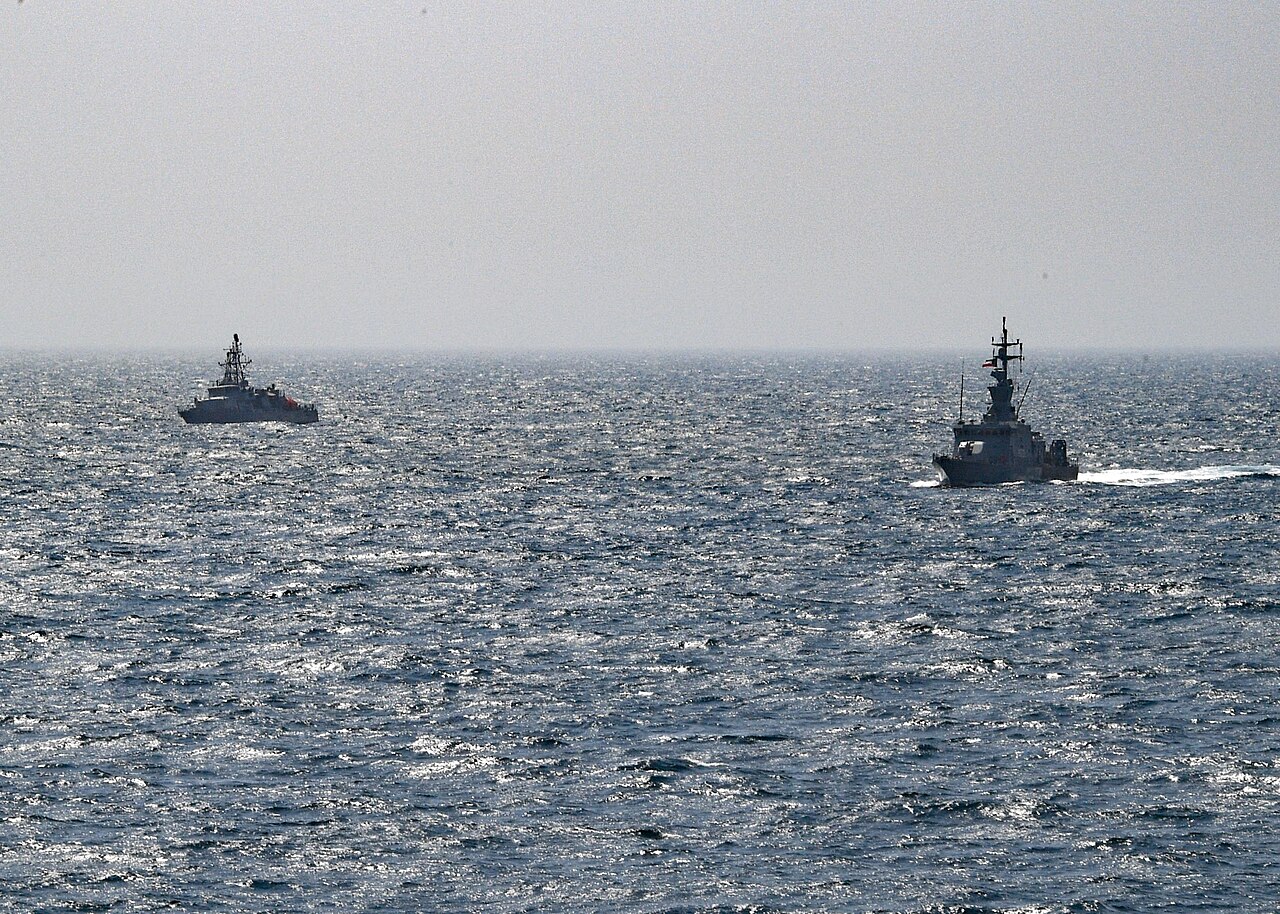 Image: Wikimedia Commons
The current crisis has been building for months, but it sharpened in April 2026 as the United States and Iran exchanged escalating threats over Tehran’s nuclear program and Washington’s renewed sanctions pressure. According to conflict monitoring platform War Monitor, the risk of a US naval interdiction of tanker traffic through the Strait of Hormuz has been assessed at severity level 8 out of 10 — a threshold typically reserved for active or imminent armed confrontation.
The scenario being war-gamed in Washington and feared in energy markets is not a full naval battle, but something more surgically destabilizing: US naval assets blocking Iranian crude exports or Iranian retaliatory action closing the strait to all traffic. Tehran has, on multiple occasions in past crises, threatened to shut the Hormuz chokepoint entirely if it felt existentially squeezed — a threat long dismissed as bluster, but one that military planners have never entirely discounted.
On the Iranian side, the calculus is grim but not irrational. Facing crippling sanctions and a leadership under domestic pressure, the ability to hold global energy markets hostage is one of the few asymmetric levers available to Tehran. Closing or threatening to close Hormuz doesn’t require winning a war — it just requires making the cost of confrontation high enough for everyone else.
Why It Matters
A sustained Hormuz blockade would be the most severe energy supply shock since the 1973 Arab oil embargo.The numbers are staggering. The U.S. Energy Information Administration has long identified Hormuz as the world’s single most critical oil chokepoint — roughly 20-21% of global petroleum liquids pass through it daily. Unlike pipelines, there is no easy bypass. The existing overland alternatives — Saudi Arabia’s East-West pipeline and the UAE’s Abu Dhabi Crude Oil Pipeline — could offset only a fraction of that volume, perhaps 4-5 million barrels per day at full capacity. The rest would simply vanish from the market.
The last time something similar was seriously threatened, in 2019, crude prices spiked 15% in a single day after drone attacks on Saudi Aramco’s Abqaiq facility took out roughly 5% of global supply. An actual blockade affecting 20% would be orders of magnitude more severe. Analysts at institutions including Goldman Sachs and JPMorgan have historically modeled Hormuz closure scenarios producing oil price spikes into the $150-$200 per barrel range — levels that would translate directly into fuel costs, inflation, and economic contraction across every major economy.
For Europe, which has already weathered an energy crisis in the wake of the Russia-Ukraine war, another supply shock at this scale would be politically and economically devastating. For Japan, South Korea, and India — which collectively receive the bulk of Gulf crude — the impact would be near-immediate and severe.
The Bigger Picture
 Image: Wikimedia Commons
Here is where the crisis takes on a dimension beyond the Middle East: China.
Beijing is the single largest importer of Iranian crude, often purchasing it at a discount precisely because US sanctions have made Tehran’s oil toxic to Western buyers. A US naval blockade targeting Iranian exports would, almost by definition, be targeting Chinese economic interests. According to Reuters reporting on the broader US-China-Iran triangle, Beijing has been explicit that it views American pressure on Iranian energy as a direct challenge to its own energy security.
The question analysts are now asking is whether China would stand aside as the US disrupted a supply chain Beijing depends on — or whether it would use its own growing naval presence in the region to contest American interdiction. China’s navy has expanded dramatically over the past decade, and the People’s Liberation Army Navy has established logistics and access agreements with several Gulf states. A direct US-China confrontation at sea, even an accidental one, would represent a catastrophic escalation with no obvious off-ramp.
From Tehran’s perspective, the prospect of China as a passive or active counter-weight to American pressure is not hypothetical — it is strategic doctrine. The 25-year Iran-China Cooperation Agreement, signed in 2021 and reported extensively by the Associated Press, commits Beijing to hundreds of billions in Chinese investment in Iranian infrastructure in exchange for discounted oil. Iran has every incentive to believe that squeezing the strait puts Beijing in an impossible position — and that Washington knows it.
Iran’s position, stated publicly through official channels, is that the United States has no legal or moral authority to restrict Iranian sovereign oil exports. Washington’s counter — that Iranian nuclear ambitions and regional proxy activities justify maximum pressure — reflects a fundamental disagreement about legitimacy that no amount of back-channel diplomacy has resolved.
What to Watch
The next few weeks will be telling. Several indicators will signal whether this escalates from a dangerous standoff into something worse:
Naval deployments. Watch the movement of US carrier strike groups into or out of the Gulf region. A second carrier in the Persian Gulf is typically a signal of serious intent. Simultaneously, track IRGC naval activity — the Iranian Revolutionary Guard Corps controls fast-attack boats and anti-ship missile batteries that can threaten tanker traffic without requiring a full naval engagement.
Tanker insurance rates. The Lloyd’s of London war risk insurance market is one of the most sensitive early-warning indicators available. When rates for Gulf transits spike, it means underwriters — who have excellent intelligence — think something is about to happen. A significant jump in premiums would reflect serious market assessment of imminent disruption.
Chinese diplomatic signaling. If Beijing publicly warns Washington against interdicting Iranian shipping, that is a significant escalation marker. If China stays publicly quiet while privately lobbying both sides, that suggests a preference for de-escalation — but not one that should be taken for granted.
Oil price movement. Brent crude breaking above $100 per barrel in sustained trading would indicate markets are pricing in real disruption probability, not just noise.
Back-channel diplomacy. European mediators, particularly from Germany and France, have historically played intermediary roles in US-Iran tensions. Watch for quiet diplomatic shuttles or off-the-record signals suggesting talks are happening beneath the surface.
The Strait of Hormuz has been called a chokehold on the global economy — and that is not hyperbole. The decisions made in Washington, Tehran, and Beijing over the coming days and weeks will determine whether that chokehold tightens into crisis or releases into an uneasy, temporary calm. The world, whether it is paying attention or not, is a hostage to the outcome.
Analysis based on conflict monitoring data from War Monitor and open-source energy and geopolitical reporting. This piece reflects the state of available information as of April 13, 2026.